
 Penguins/NHL
 PENS – FLYERS FALLOUT
What Went Wrong: Breaking down Penguins 4-3 Overtime Loss In Game 1
One reason I haven’t been ready to jump on the Penguins bandwagon in recent days and proclaim them as heavy favorites to win the Eastern Conference and even the Stanley Cup like many NHL pundits have, has been because of their defensive issues and Marc Andre Fleury’s inconsistent play in the post-season since 2010 where he’s 10-11 in his last 21 playoff games with an .891 save percentage. After game 1, I’m still not sold on both.
[instory]
What has plagued the Penguins for a while now is poor puck management in the neutral zone, struggles to defend the cycle and losing players in space in the defensive zone. They all showed up Wednesday night.
Opposition Getting Behind Penguins: The first issue to attack for the Penguins is how susceptible they are to letting the opposition get behind them. It happened twice in Game 1 and has been a common problem for weeks.
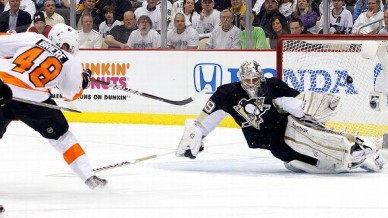
With Pittsburgh dominating play and leading 2-0 in the first period, Jaromir Jagr got behind Zbynek Michalek, receiving a stretch pass and coming in on a breakaway against Marc Andre Fleury who made a pad save to preserve Pittsburgh’s 2-0 lead.
Pittsburgh though would later pay when Danny Briere got behind Paul Martin and Brooks Orpik on a clear off-sides, scoring a breakaway goal at 6:22 of the second period to get Philadelphia back in the game.
Regardless of the fact that Briere should have been called off-sides, why the Penguins remain so vulnerable in this area is mind boggling. Yes, the Penguins poor puck management in the neutral zone has been their achilles heel and was in Game 1 especially on the Briere goal where Joe Vitale lost the puck at center ice, but the Penguins defensemen deserve just as much blame as they get caught too far up the ice and struggle with their awareness of the situation.
Defending the Cycle: Coming into the series, it has been well documented that the Penguins are vulnerable defensively against the cycle and it was likely going to be an area the Flyers could exploit. How effective Philadelphia was in Game 1 on the cycle should not have been a surprise.
“They had repeated pressure in just a short amount of time, ” head coach Dan Bylsma said on the overtime goal.”
An argument is the Penguins struggles on defending the cycle can be pointed to a personnel issue but a big issue continues to be the forwards getting caught watching the puck and losing an open player in space. The overtime goal by Jakub Voracek was a prime example of that. Matt Carle throws a puck to the net and Jordan Staal never picks up Voracek at the side of the net, as his eyes are set on the puck the whole time, a poor play from one of the best defensive centerman in the game.
A positive outlook is that It’s a fixable thing in the defensive zone with players just needing to show more attention to details and awareness of their surroundings, but it hasn’t been fixed yet.
X’s and O’s
*Notes after the 2nd period I worked up last night on the Penguins dominance early on, Plus “What we Learned” segment from Game 1*
First up, A look at the good from the Penguins in the 1st period
Pens were Buzzing from the Start
The Penguins came out of the gates buzzing and they were the quicker and faster team, winning numerous battles for the puck and they set tone just minutes into the game by coming at the Flyers and near the 2:30 mark, the Penguins 4th line established a presence down low setting up a sequence where the Penguins would dominate play for the next minute in a half.
Pittsburgh forced 2 icing calls in the first 3:12 of the game,
and following an offensive won faceoff by Sidney Crosby at 3:22 of the first period, Pittsburgh worked down low and Crosby scored 3:43 into the period, finding a loose puck in Nicklas Grossman’s legs to get the Penguins rolling in the first period.
Transition Game was electric than went away
Where the Penguins dominated play early on was in the transition game. Pittsburgh had Philadelphia on their heels and Tyler Kennedy’s first period goal at 7:49 of the period was a sequence of when the Penguins are at their best in transition.
Kris Letang creates a turnover in around the high slot in the defensive zone and quickly gets the puck up to Jordan Staal who goes the other way in what should have been a 2-on-2 rush. Kennedy though outhustled Jaromir Jagr who was gliding on the backcheck and Staal feeds Kennedy for the goal.
While in the first period the Penguins were excellent in transition, Philadelphia made needed adjustments in the final forty minutes of the game, and became more aggressive in the neutral zone, not letting the Penguins come at them with top speed.
Pens didn’t keep pressure on Grossman
The Penguins had a great game plan early on in attacking the Flyers defensemen hard on the forecheck and hitting them at every opportunity they had. Most notably, Pittsburgh seemed to be targeting shutdown defenseman Nicklas Grossman who had the primary matchup against Evgeni Malkin
“In first period, we did too much standing, too much watching, and we became targets to hit and we just didn’t move well, ” Flyers head coach Peter Laviolette said. Through the first 32 minutes of the game, Pittsburgh delivered six hits on Grossman, zero after that. In the first half of the game, Grossman was looking to see where the next hit was coming from, nearly everytime he went back to retrieve the puck. However, as the game progressed, the Penguins weren’t coming with the same intensity and things became much easier for Grossman and others.
WHAT WE LEARNED
— Brayden Schenn, the games No. 1 star with a goal and two assists, is already a big factor in the series and he brings a lot to the table. You saw why the Flyers coveted him as a centerpiece in the Richards trade. He’s only going to get better in this series.
— Danny Briere is one of those players who just turns it up a notch in the playoffs. What stood out with Briere was also how effective he was at the little things, like being a factor on the forecheck and surprisingly being tough to move off the puck, something he’s not known for.
— While the Penguins play dangerously defensively in the neutral zone, Philadelphia is just as dangerous with their defensemen pinching in the offensive zone. It’s their identity as a team but there are some many 50-50 plays that were there in Game 1 and will be the rest of the series where a chip around the Flyers D will have Penguins off to the races with odd-man rushes.

Related posts:
 Pens – Flyers: Post-Game reactions on Flyers win, Pens getting away from “their game”, power play woes & more
Game 1 Preview/Scouting Report: Breaking Down Flyers – Penguins
Post-Game: Crosby scores twice in 1st period as Pens dictate play in final 40 minutes
Penguins – Canucks Fallout: Malkin’s Dominance; Heavy Pens presence at Avs game
Pens – Flyers: Post-Game reactions on Flyers win, Pens getting away from “their game”, power play woes & more
Game 1 Preview/Scouting Report: Breaking Down Flyers – Penguins
Post-Game: Crosby scores twice in 1st period as Pens dictate play in final 40 minutes
Penguins – Canucks Fallout: Malkin’s Dominance; Heavy Pens presence at Avs game
 Geno Stay One More Year